From Idea to Experience: Refining Our Solution Through Iteration
- Tamar Sasi
- Mar 23
- 3 min read

During the semester break, our focus shifted from exploration to precision.
After weeks of research, interviews, and validation, this phase was about taking everything we had learned and turning it into a clear, cohesive solution: from concept to concrete experience.
Revisiting the Core Problem
We began by grounding ourselves again in the problem we set out to solve.
In social and family settings especially around shared moments like dinners. Political conversations often lead to emotional tension, avoidance, and even disconnection. People want to engage, but choose not to, out of fear of conflict or harming relationships .
This insight continued to guide us as we refined our direction.
Clarifying the Solution
Over the break, we defined our solution more clearly than ever before:
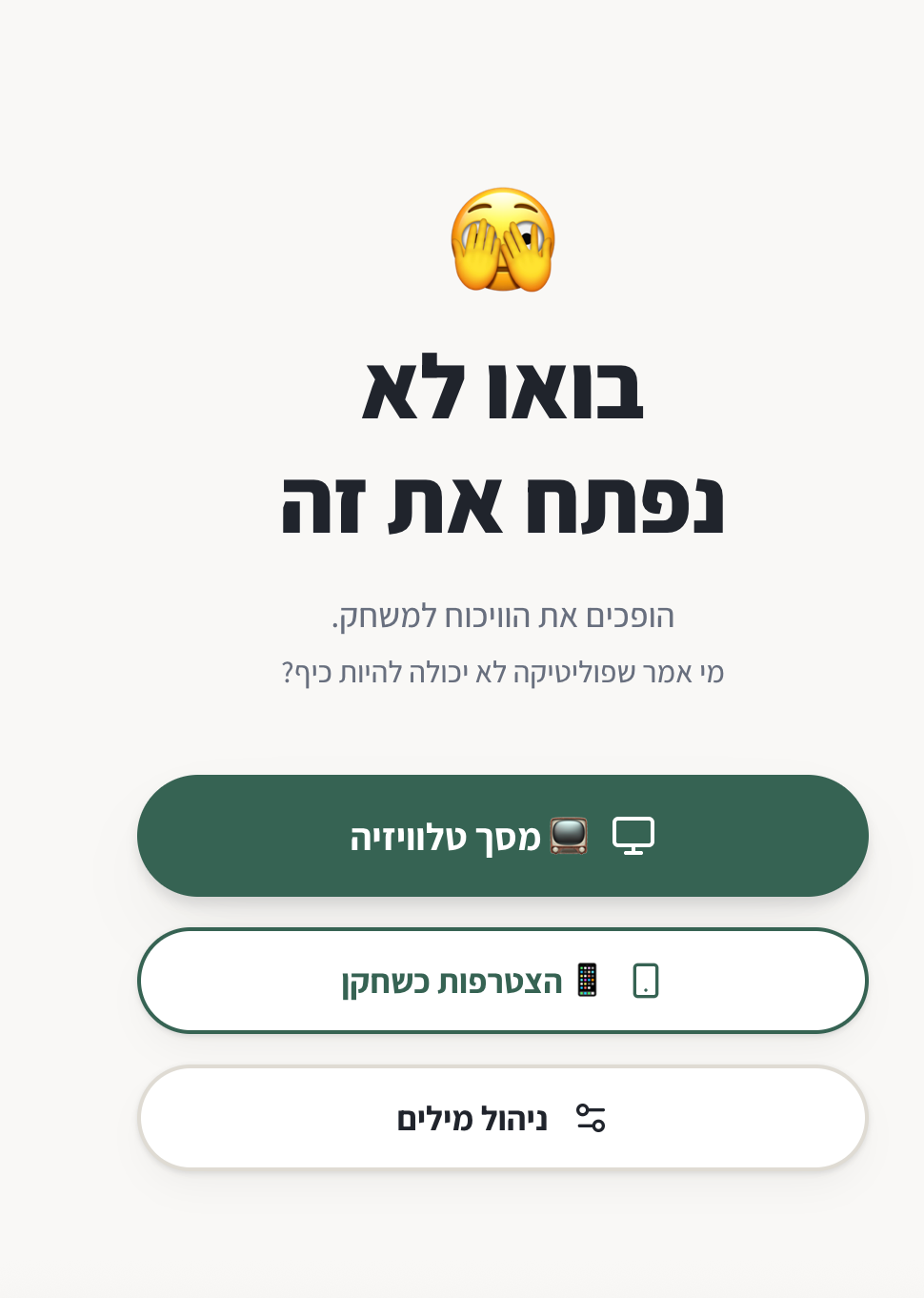
A social, TV-based game experience that transforms sensitive political conversations into something playful, shared, and non-threatening.
The experience combines:
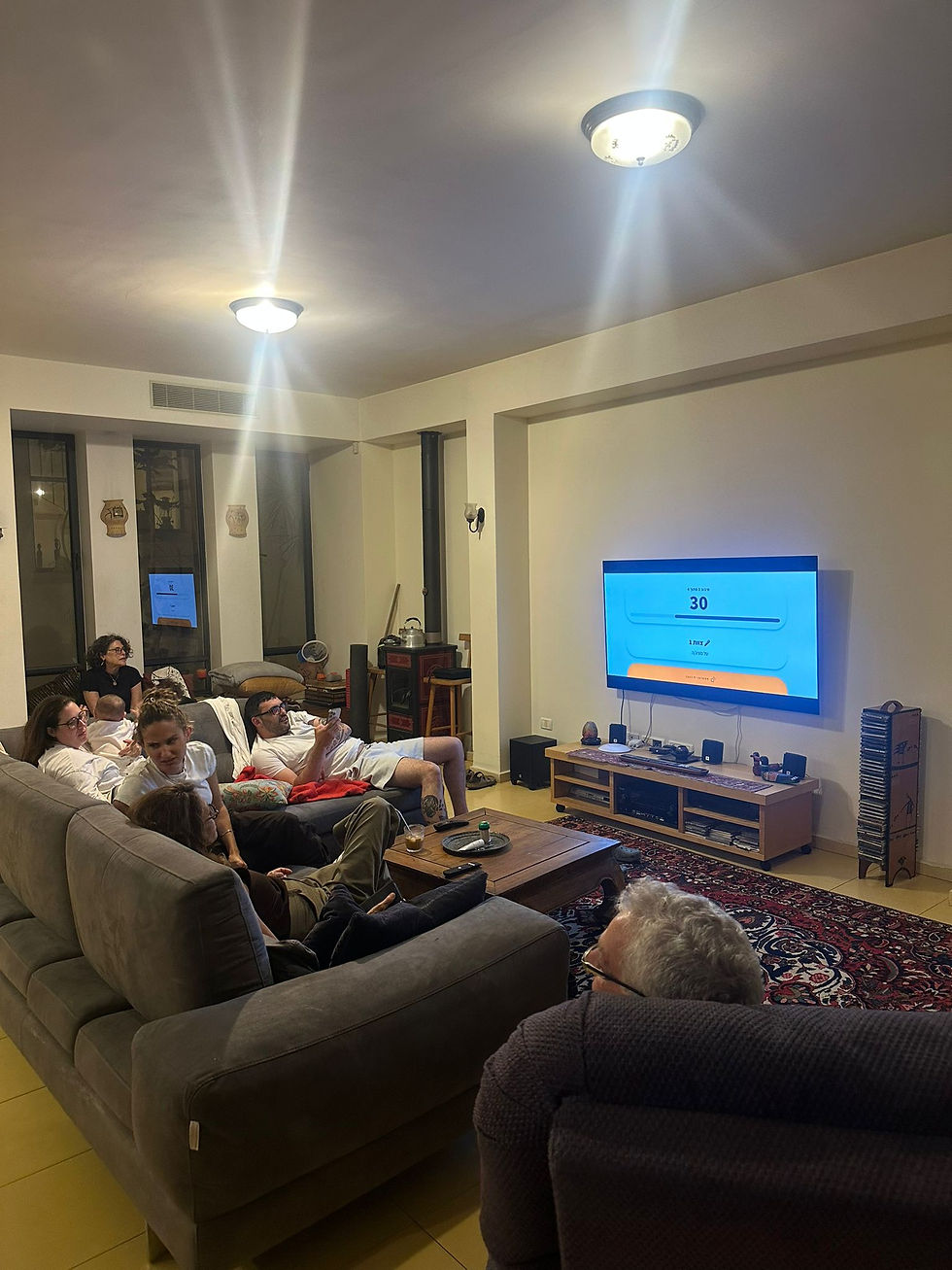
A central screen (TV) that manages the game flow
Personal mobile devices for each participant
A physical element (dice) that introduces randomness, humor, and interaction
This hybrid structure of digital + physical was not accidental. Through testing, we saw that the physical component adds a layer of spontaneity and lightness that purely digital interactions lack.
Designing Through Scenario
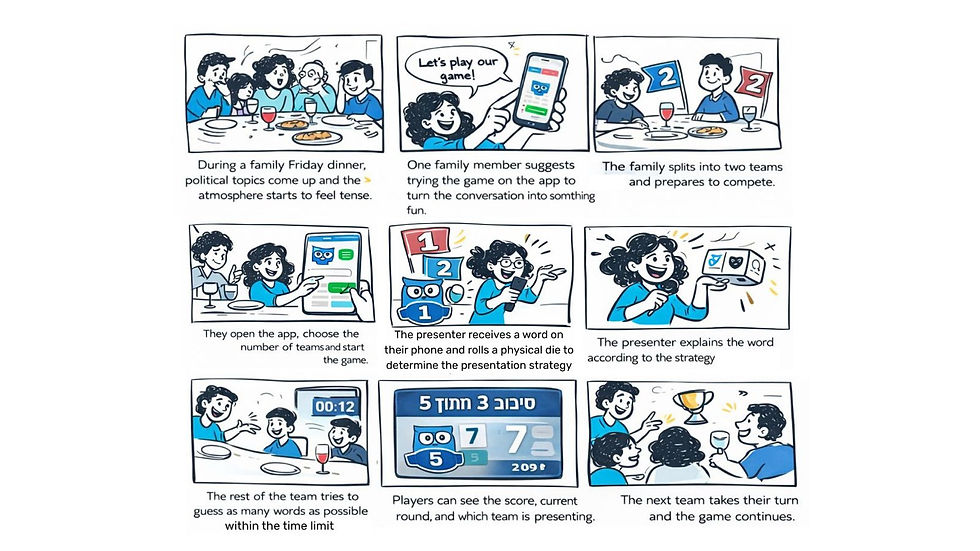
To better understand how our solution fits into real life, we developed a clear scenario around a familiar moment: a family dinner where political tension begins to rise.
Instead of avoiding the conversation or escalating it, one participant introduces the game as a way to shift the atmosphere. The experience creates a structured transition: from tension to play allowing participants to engage with the same sensitive topics, but in a different emotional frame.
Through role-playing, humor, and shared interaction, the conversation moves away from personal confrontation and toward a more open and curious dynamic. Even without resolving disagreements, something changes: the tone softens, people listen differently, and the relationship remains intact.
This scenario helped us ground the solution not just as a concept, but as a real intervention in a real moment.
Designing the Experience
We moved from a general idea into a fully structured experience.
The game is built around:
Teams competing in short, 60-second rounds
Players presenting political concepts without stating them directly
Different presentation strategies, such as:
Presenting the opposite opinion
Exaggerating a position
Presenting it in a classic way
Importantly, the goal is not to convince but to play, guess, and engage.
We also introduced new mechanics:
Random events and interruptions
Special cards (e.g., “freeze,” “team assist”)
Increasing difficulty levels
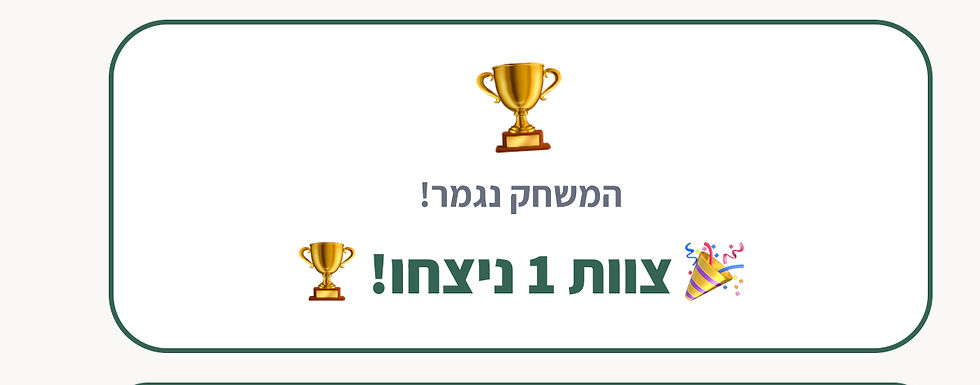
Real-time scoring and competition
All of these were designed to increase energy, reduce overthinking, and keep the interaction dynamic.
Iterating Through Playtesting
A major part of our work during the break was continuous testing and iteration.
We conducted five rounds of playtesting, each focusing on a different design question.
As shown in the iteration summary (see page 10), each round helped us refine a specific aspect of the experience:
What should be physical vs. digital
How to increase relevance through real-world content
How competition affects engagement
How to make the experience feel lighter and more accessible
And finally, how everything works together as one cohesive system
Through these iterations, the experience gradually became more fluid, dynamic, and naturally suited for social group settings.
What We Learned
One of the most important insights from this phase was that structure creates freedom.
When the experience is too open, participants feel pressure.But when there are clear rules, time limits, and playful constraints — people relax, engage, and even enjoy the interaction.
We also saw that:
Humor reduces tension
Competition increases energy
Distance from personal opinion enables participation
And gradual onboarding (starting easy → increasing complexity) makes a big difference
As summarized in our experience principles, the shift is simple but powerful: fromdebate to play, from being right to playing together
Looking Ahead
This phase helped us move from a promising idea to a well-defined experience.
We now have:
A clear concept
Defined mechanics
Tested iterations
And strong experiential principles
Our next step is to translate this into a digital prototype, while continuing to validate the experience in real-life contexts.


Comments