How Might We…?
- Tamar Sasi
- Nov 25, 2025
- 3 min read

This week was all about sharpening our understanding of the problem and starting to frame it as a design challenge. After interviewing more students, reviewing psychological theories, and gathering quantitative research, we began shaping a clearer picture of our users, their emotional barriers, and the real conditions in which avoidance of dialogue appears.
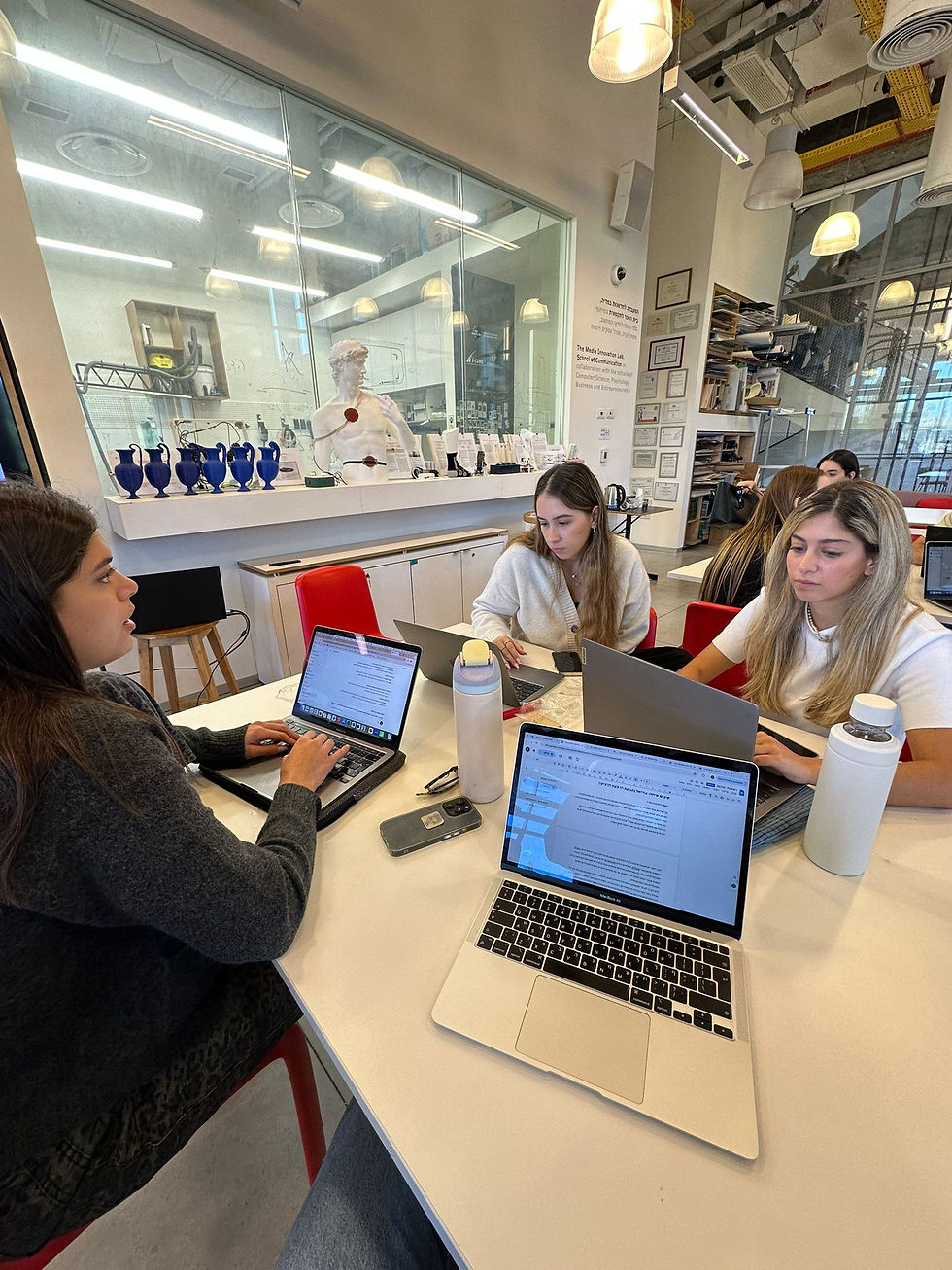
The more conversations we had with students, the more we realized how consistent the patterns are. Students across different campuses still describe the same fears: judgment, labeling, confrontation, or simply the feeling that “nothing will change.” These new interviews helped us deepen our understanding of when and why they choose silence and what they need in order to feel safe enough to speak.
Refining Our Target User and Context
As we moved closer to defining our specific problem, we revisited our interviews from previous weeks and added several new ones. This helped us focus not only on “students” in general, but on the particular emotional and social context in which their avoidance happens.
From the insights gathered, it became clear that the moments in which students avoid speaking are not random. They tend to happen in mixed groups, in public academic spaces, or in settings where they feel watched, judged, or intellectually exposed. Students want to take part in dialogue but they will do so only when the environment feels respectful, calm, and genuinely open.
Revisiting User Needs Through Research
This week we also validated the needs we identified through psychological theories and academic literature.Concepts such as Spiral of Silence (Noelle-Neumann, 1974), the Chilling Effect, and Filter Bubbles helped us understand why students often silence themselves even when they have something important to say. People tend to avoid expressing opinions when they fear becoming a minority, being judged, or losing social standing. This mapped directly onto our interview data.
In addition, we collected quantitative data showing the global scope of the problem: 2 out of 3 students self-censor in class, 48% of Gen Z admit hiding their voting choice from friends or family, and 55% of Americans avoid sharing opinions altogether. Seeing these numbers helped us confirm that what we’re observing on campus is part of a much broader trend.
Existing Behaviors and Workarounds
As part of the assignment this week, we looked at “solutions students already use” and the workarounds they rely on today. Our analysis highlighted that most strategies are forms of withdrawal rather than engagement. Students avoid certain conversations, stick to people who think like them, or shut down discussions the moment they sense hostility. These behaviors protect them emotionally but also prevent meaningful learning, growth, and connection.
Understanding these substitutes helped us see the gap our solution must address: students need a way to engage without feeling threatened.
Shaping Our “How Might We” Question
After synthesizing insights, mapping needs, and reviewing literature, we finally reached the central moment of this week: drafting our How Might We question.
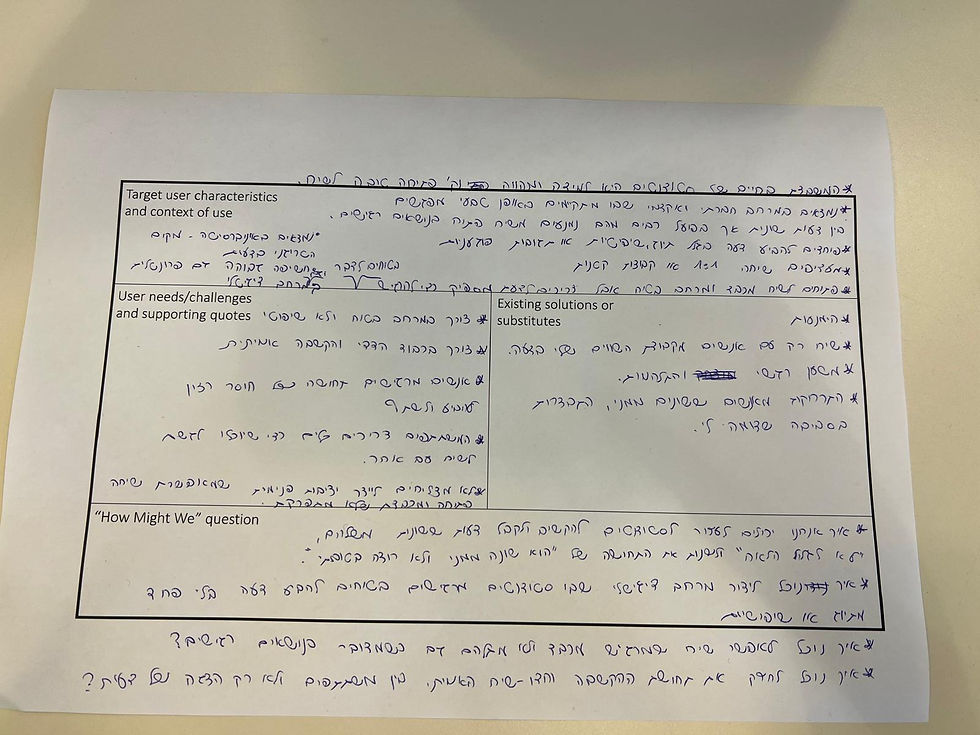
Our brainstorming led us to explore different angles around listening, emotional safety, motivation, and the perception of “the other.” Guided by the template from class, we began forming questions that connect a specific user, a specific challenge, and a desired outcome.
Some directions included:How might we help students feel safe enough to express their opinions?How might we enable respectful dialogue even around sensitive topics?How might we increase students’ willingness to listen to perspectives different from their own?
These questions will guide the next stage of the Double Diamond as we move from DEFINE toward IDEATE.
Creating Our Presentation
By the end of the week, we compiled everything: insights, quotes, literature, statistics, and the refined user profile into a clear and structured presentation. This helped us visualize the process so far and communicate our findings as a group. The slide deck shows the full path from the initial problem to the emerging design challenge, and allowed us to clearly see how each layer supports the next.


Comments