Validating the Concept
- Tamar Sasi
- Jan 7
- 3 min read

This week was dedicated to validating our solution in the real world.Rather than refining interface details or content, our goal was to test the core idea:Does a playful, structured experience actually help reduce emotional tension around sensitive political topics?
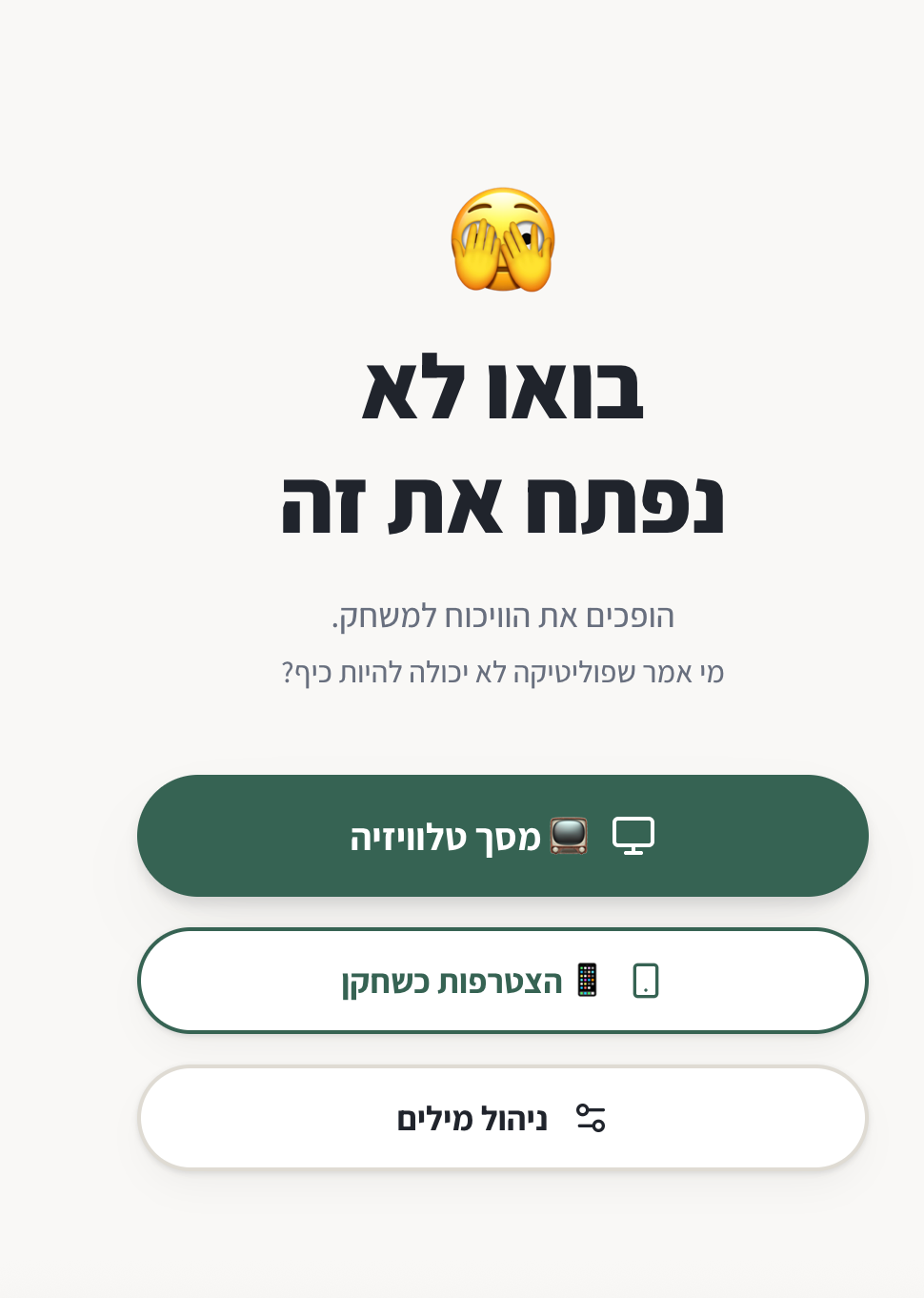
To do this, we built an analog version of the game and tested it in real social settings, followed by a class presentation summarizing our findings.

Testing the Idea Outside the Lab
Our initial plan was to test the experience in family settings, since close relationships are the primary context we are designing for. In practice, this proved challenging.
In one family, the presence of young children made the activity feel inappropriate for the moment. In another case, the family actively resisted the idea and chose not to participate at all. These moments were important signals: even when people strongly relate to the problem, they may not be emotionally ready to engage with it.
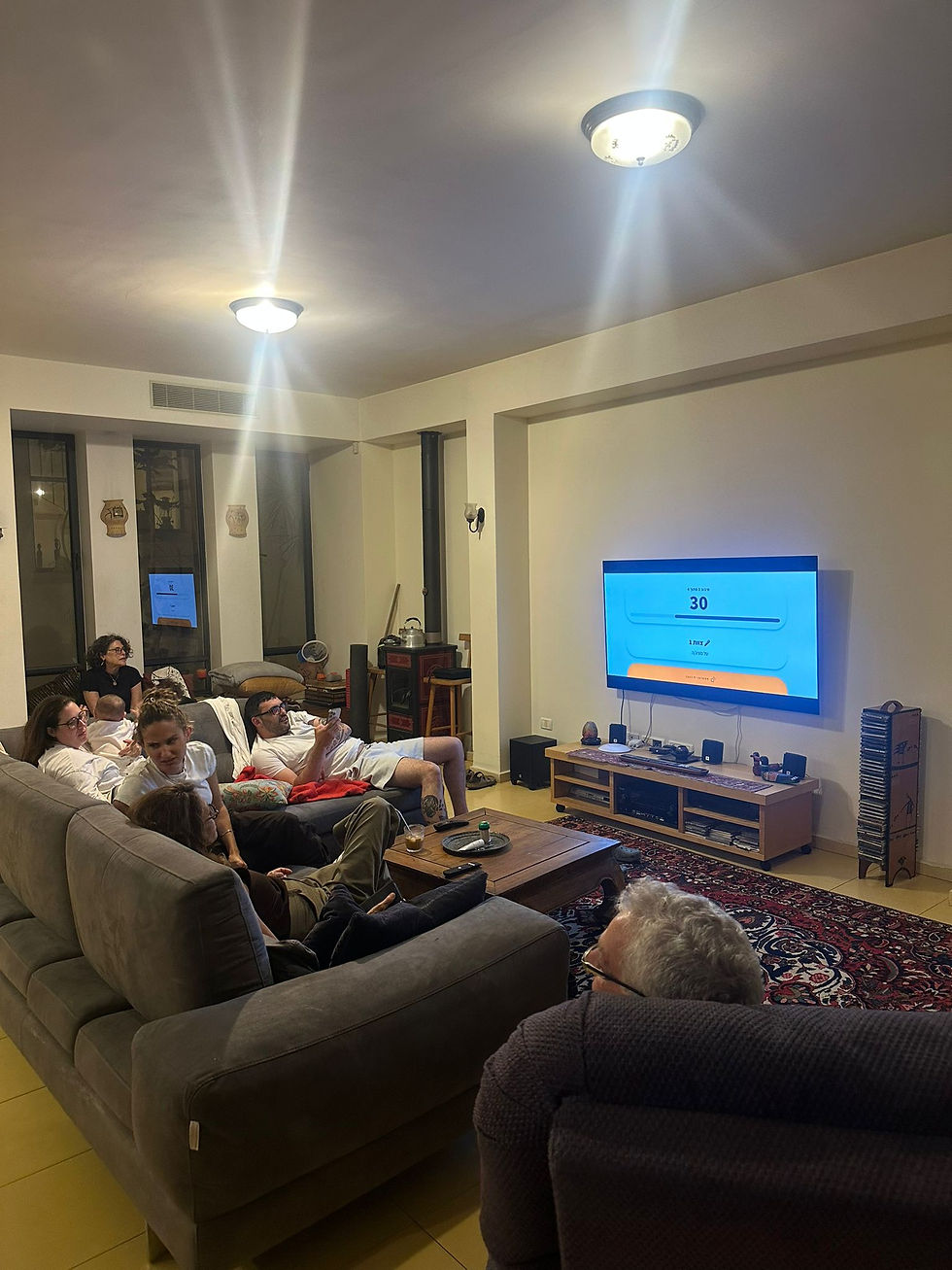
Eventually, we were able to test the experience with two groups of friends who agreed to participate. While not our ideal target context, these sessions allowed us to observe how people responded to the mechanics, tone, and emotional framing of the game.
What We Expected vs. What Actually Happened
We initially assumed that framing the interaction as a game would naturally lower tension and make participation feel easy. In reality, the transition into play was often awkward and felt forced at first — especially when political tension had already surfaced earlier in the evening.
Participants reported that starting the game after a heated moment made it harder to shift mindsets. Some struggled with the openness of the task, finding it cognitively demanding to quickly invent ways to present abstract political concepts.
At the same time, once the game progressed, something began to shift.Over time, participants became more relaxed, humor emerged, and moments of genuine listening appeared. Role-switching — presenting positions that were not necessarily their own — created emotional distance and reduced defensiveness.
What the Research Helped Us Understand
Alongside validation, we deepened our literature review — and found strong theoretical support for what we observed in practice.
Research on humor in politically divided families shows that humor can function as a play frame — a temporary emotional bubble that allows people to engage with threatening topics without fully activating conflict. Carter and Davies (2025), in their qualitative study of British families during Brexit, describe humor as a learned skill rather than a universal solution. When used sensitively, humor helps maintain connection and ease tension; when mistimed, it can increase distance. This aligns closely with our findings that humor helped only when the interaction felt safe and voluntary.
We also explored research on paradoxical thinking as a conflict intervention. Hameiri et al. (2018) demonstrate that encouraging people to exaggerate or play out their own positions in an extreme way can reduce rigidity and open space for reflection — especially among individuals with strong, polarized views. Rather than confronting people with opposing information, paradoxical thinking creates a moment of internal tension that promotes cognitive flexibility.
Additional theoretical work suggests that such intra-individual conflict — briefly holding contradictory ideas — can reduce attitude polarization without requiring agreement (Sassenberg & Winter, in press). Importantly, these approaches work not by persuasion, but by disrupting automatic thinking patterns.
Together, these studies helped us understand why our game mechanics — role assignment, exaggeration, humor, and distance from personal identity — began to work once participants settled into the experience.
Presenting the Validation to the Class
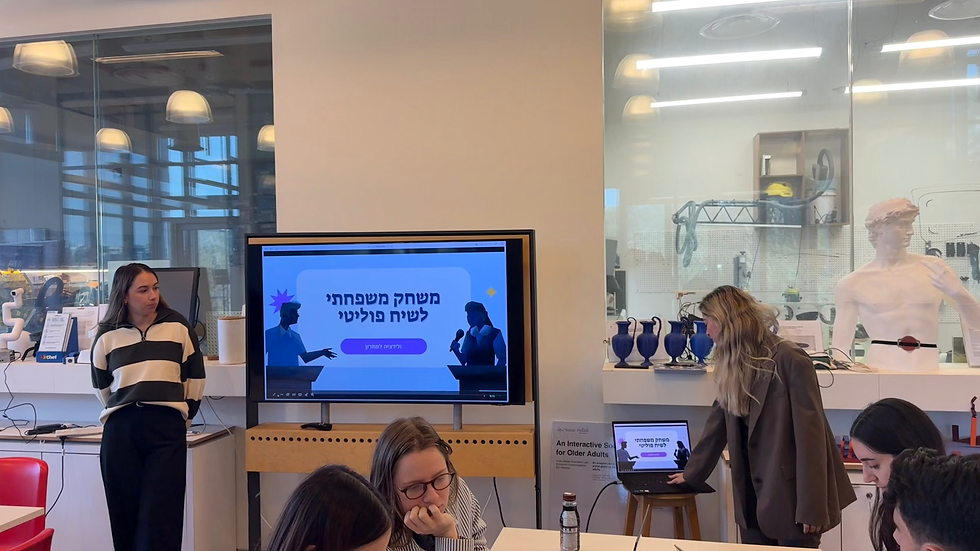
At the end of the week, we presented our validation process and insights to the entire class. Rather than focusing on success alone, we openly shared resistance, refusal, and discomfort — alongside the moments where the experience did create relief, laughter, and listening.
This presentation helped us clarify that readiness, timing, and consent are not secondary considerations, but core design challenges we must address.



Comments